How to Swing for Lethal in the One Piece Card Game

The last decisions you make in a game of One Piece are often the most difficult. How you sequence your attacks, how you size them, which bodies you commit DON!! to: each choice can mean the difference between closing out a winning board and losing by 1000 measly counter.
The skill we're talking about here is lethal math, and while it looks intimidating at first, most of it can be boiled down to a handful of heuristics and repeatable patterns you can train your eye to spot, starting with this guide.
Now before we get started: this article covers the foundation of lethal math in One Piece. But once you're comfortable with the basics, the rabbit hole goes deep, from hand reads, to opponent deck knowledge, to tracking trash, to playing mind games. The scenarios below assume the worst-case scenario for you: that every card in your opponent's hand has +2000 counter. In practice, it almost never does, and the players who win close games are the ones who can read the situation well enough to deviate from these textbook lines.
Basic Heuristics
Before we get into specific lethal scenarios, let's cover a few high-level rules of thumb that'll come into play when we start looking at real board states:
- Each card in your opponent's hand represents a maximum of +2000 counter power (if they have no DON!! up). If your opponent is a 5000-power Leader and has one card in hand, a 7000-power swing will always hit. If they have two cards in hand, a 9000-power swing will always hit, and so on.
- Think of each Life card as an infinite-counter, free-to-play Event that also draws a card. If your opponent has one Life and your two swings must go through, one of those swings will effectively be negated for free.
- Think of each blocker as another Life, except it doesn't draw when used.
- To go for lethal, you need at least one more swing than your opponent has Life. If your opponent has 0 Life, you need 1 swing. If they have 1 Life, you need 2 swings, and so on.
- Every attack demands a response. It sounds obvious, but if your opponent has no counter in hand, they can't even answer a 5000-power attack. Likewise, if they're only holding +4000-counter Events or +2000-counter Characters, they'll need to burn those to counter out of 5000-power swings.
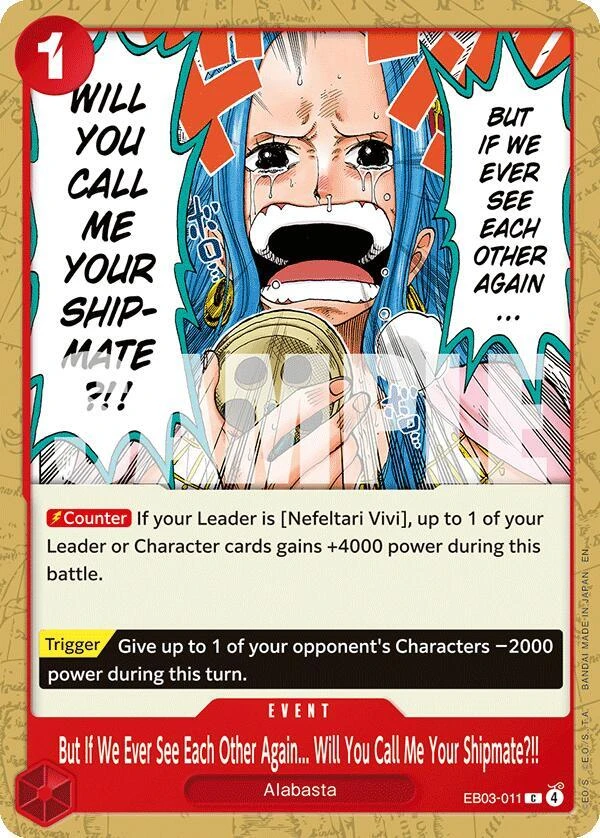
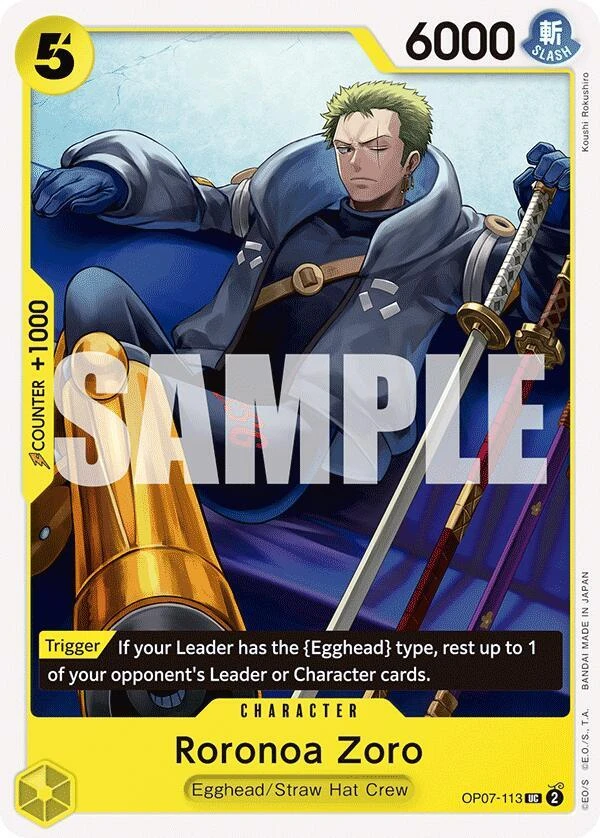
- For every DON!! your opponent has standing, count each card in their hand as having potentially +4000 counter power. This is why lethal math gets significantly harder if your opponent has DON!! up.
- Be careful of triggers! It takes deck knowledge, but if your opponent's deck has triggers that can rest or KO your Characters, you'll want to swing with those Characters first.
Math Lethal: Swing Bigger Than Your Opponent Can Counter
The first situation we'll discuss is when you have enough power on the board to mathematically guarantee you'll win the game, also known as "math lethal."
These situations won't be immediately obvious when you start playing One Piece, but there are a few windows to look out for:
- When your opponent is at 1 Life, math lethal is usually realistic when they have up to 3 or 4 cards in hand.
- At 2 Life, around 1 or 2 cards.
- At 3 Life, basically only at 0 cards.
Outside those windows, guaranteeing lethal gets very difficult.
If your opponent is ever within these windows, or you're able to stick a board full of powerful bodies (Blue Red Ace players will know what we're talking about), just calculate your maximum swing power, calculate the maximum counter they'd need to get out of those swings, and check if you have math lethal.
To help you do this, just remember: each of your opponent's cards represents a maximum of +2000 counter, so if you swing 2000 above your opponent's Leader power per card in their hand, it's impossible for them to counter.
Here's an example: If they have one card in hand, no DON!! up, and 2 Life, you are guaranteed to win the game if you swing for 7000, 9000, then 11000 (barring some game-altering Trigger effect).
It may sound overwhelming at first, but the more you play the game, the more you'll get a feel for these thresholds and finding math lethal situations will become second nature.
But what about the situations where math lethal isn't on the table? For those, the best we can do is identify our optimal swing numbers—that is, the ones that maximize pressure and minimize the cards our opponent has left to work with.
Luckily, we can break these down into a few clean scenarios.
Opponent at 0 Life: Use Extra Attacks to Poke
When your opponent is at 0 Life, the first instinct is usually to jam every DON!! onto your biggest body and send it. If you only have one attacker, that's fine. But if you have more, be careful.
With multiple swings available, the best approach is often to poke first by swinging at equal power to your opponent's Leader, even if it means committing a DON!! to a smaller body to get there. From there, you're looking to swing either at your opponent's Leader's power, or in increments of 2000 above it.
Here's an example: If your opponent's Leader is 5000 power and you have a 4000-power body, a 6000-power body, a 5000-power Leader, and 10 DON!!, you should swing for 5000, 5000, then 15000.
The reason for this goes back to the "each attack requires a counter" heuristic we discussed above.
If your opponent's hand is all +2000-power counters, they have to use one card to counter out of each 5000-power swing—which drains an extra card for the same amount of counter power.
Let's do the math:
- 6000 / 15000: They need a +2000 counter for the first attack, then five +2000 counters and a +1000 counter for the second. That's 13,000 counter across 7 cards.
- 7000 / 14000: Also 13,000 counter across 7 cards.
- 5000 / 5000 / 15000: Still 13,000 counter—but now across 8 cards.
In addition to requiring a whole extra card, each swing in our 5/5/15 sequence is either a poke or an increment of two above the opponent's Leader, which gives us more opportunities to exploit our opponent for sub-optimal counters.
Opponent at 1 Life: Spread Your Attacks Evenly (Usually)
When our opponent is at 1 Life, things get trickier. Since one of their Life cards will absorb a swing for free, the best practice here is to make your swing numbers as even as possible.
Say we have a 6000-power Character, a 10000-power Character, our 5000-power Leader, and 10 DON!! available. The optimal line is 10000, 10000, then 11000.
Why such equally-spread numbers? Well, if we swing for too low of a number, we make it easier for our opponent to counter out of one of the swings. If we swing too high a number, we make it too easy for them to take a Life (which remember, is a free infinite counter that draws a card). Spreading out our power makes each attack equally threatening and no single swing is more exploitable.
There is a notable wrinkle to this strategy, however, and that comes into play when you have an excess of swings where at least one of the attackers is a small body.
The textbook example is a board state where we have a 0-power Character on board, an 8000-power Character on board, our 5000-power Leader, and 10 DON!! up. If we were to go by the rule above, we'd split our DON!! for 11000 and 12000.
But the optimal opening swing is actually 10000.
This one takes a second to wrap your head around, so let's build up to it. The 11000 swing is, in a sense, wasted: if the opponent takes the Life damage, they effectively absorb it for free. We'd much rather save that DON!! for the swing that has to be answered with counter.
With only two attackers, we were forced into splitting evenly just so neither swing was a pushover. But again, that was a compromise.
Adding a third body, even though it has 0 power, changes the math, allowing us to safely adjust our swings to a more advantageous 10000/13000 split without demanding any less counter from the opponent. Why? Because if they counter the 10000, we can then swing for 6000 and 7000 with our remaining two swings, which, if you math it out, demands more cards and more counter than the line opening with an 11000-power swing.
So, in board states where you have more swings than you need for lethal and at least one is a smaller body, check whether you can drop your opening swing lower while still demanding the same total counter. If they take the first swing to Life, you're left with a bigger follow-up. If they counter it, you haven't lost anything.
Opponent at 2+ Life: Don't Commit DON!! Too Early
Once your opponent is at 2 Life or higher, lethal becomes much harder to guarantee, and the optimal lines get much harder to calculate. At this point, rely on the heuristics we've already covered and keep the following in mind:
- Open with a powerful swing that requires as little DON!! investment as possible. You know you're swinging for lethal, but your opponent doesn't. If you open with a raw 8000-power swing, they may just take it, worried about whatever you're going to play next instead of the attacks already on the table.
- Swing at least 2000 above your opponent's Leader to open. This deep in the game, you want to either take Life cards or strip as many cards from their hand as possible, and 5000-power swings usually won't do either.
- Leverage everything you know about your opponent's hand. If they searched a card with no counter value, you can effectively subtract a card from your calculations. If their trash is empty of +2000-counter cards, you can reasonably assume their hand is stacked with them, making 2000-increment attacks even more punishing.
- Once you've pulled them down to 1 or 0 Life, refer to the best practices described above.